How to Get More Facebook Post Shares
Facebook has evolved far beyond a social networking tool for friends. With over 3 billion monthly active users, it sits among the most active content distribution platforms anywhere online. And yet most pages and businesses are capturing only a fraction of its potential. The reason is simpler than most people expect: they’re chasing likes when shares are what actually move the needle.
A like takes less than a second. A share, however, requires a conscious decision. When someone shares your post, they’re endorsing it publicly and telling their own audience that it’s worth their time. This kind of endorsement drives real reach, real traffic and real credibility in a way that passive reactions simply don’t.
If growing your Facebook presence is the goal, shares need to be at the centre of how you think about content. Here’s how to actually make it happen.
Why Shares Matter More Than You Think
Facebook’s algorithm doesn’t treat all engagement equally. For instance,
- Likes are passive signals.
- Comments indicate some level of interest.
- Facebook Post Shares carry the most weight because they push content into new feeds and new networks, audiences you could never reach from your own page alone.
A post with 50 meaningful interactions can outrank one with thousands of passive likes. It is how Facebook actually ranks content. Shares also generate secondary engagement: when a post is reshared by someone, their followers can like it, comment on it and share it further. This network effect is what separates shares from every other type of interaction.
If more shares is the outcome you’re after, everything from your content format to your timing and your call to action needs to point in the same direction.
Create Content People Actually Want to Pass On
Before tactics, the content itself has to earn the share. Not just informative or well-designed, but genuinely useful or personally resonant to whoever is reading it.
1. Make It Emotional or Personally Meaningful
People share things that say something about who they are. A post that sparks a feeling, whether it is inspiration, recognition, humour or something relatable about a frustration they’ve had, is far more likely to be shared. Think about what your audience connects with on a personal level, not just what’s relevant to your product or service.
A simple test before posting: ask yourself whether someone would actually send this to a friend. If the honest answer is no, rework it before it goes live.
2. Tap Into Topics That Need to Be Said
Some of the most shared content gives voice to something people are already thinking but not seeing discussed. A post that identifies a real pain point, challenges a common misconception or brings an underrepresented perspective to the surface gives readers a reason to share it simply because it fills a gap.
This kind of content builds your page into a voice worth following rather than just another brand pushing posts.
Use Visuals That Stop the Scroll
Photos as well as videos consistently outperform text-only posts for reach and engagement. Visuals get processed faster, take up more room in the feed, and feel more inherently shareable.
1. Choose Strong Images with Context
A good image communicates something on its own. Pairing a strong visual with a short, direct caption gives people both a reason to stop scrolling and a reason to share. Avoid generic stock photos. Use visuals that feel specific, real as well as directly aligned with your message.
2. Keep Videos Short and Front-Loaded
The first three seconds decide whether someone watches or moves on. If you’re using video, communicate your core message immediately. State what it’s about, show something worth seeing and deliver value fast. Short content that respects people’s time earns more shares than longer videos that take too long to find their point.
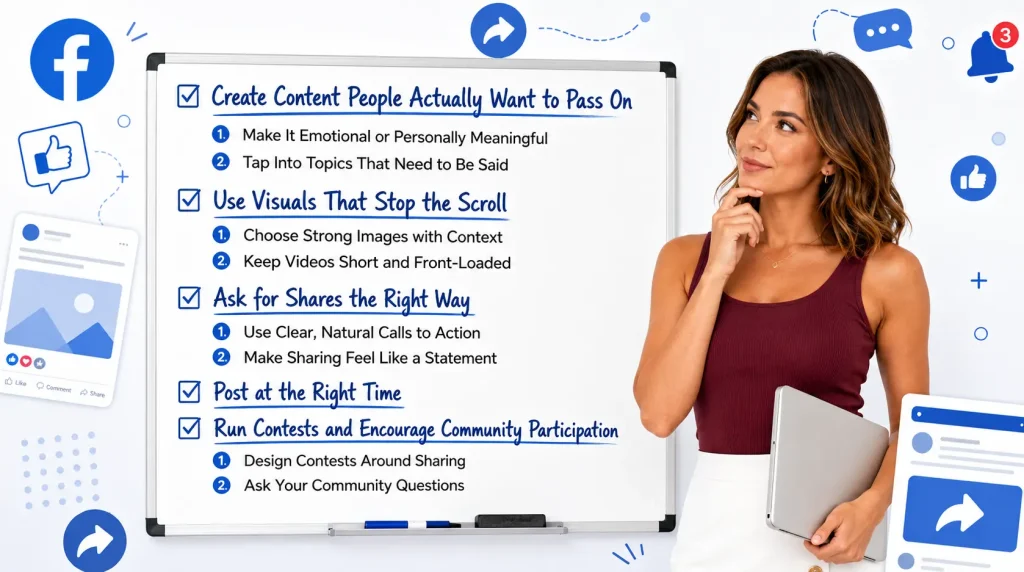
Ask for Shares the Right Way
Most page owners never directly ask for a share. Those who do, while maintaining a natural tone, consistently see better results.
1. Use Clear, Natural Calls to Action
A CTA doesn’t have to feel like a pitch. Phrases like “share this with someone who needs to hear it” or “tag a friend who would find this useful” give your audience a natural reason to act. The key is to make sure the ask is logically connected to the content. If the CTA appears arbitrary, people will skip right past it.
Including calls to action in Facebook posts has been shown to increase shares alongside likes and comments. What works specifically will depend on your audience and content type. Still, testing CTAs consistently is worth building into your process.
2. Make Sharing Feel Like a Statement
People often share content because it gives them a way to say something about themselves. When a post connects to an identity, a value or a belief that your audience holds, sharing it becomes a form of self expression rather than just a click. Framing like “share if this sounds familiar” or “pass this along to anyone building something from scratch” taps directly into a viewer’s instinct.
Post at the Right Time
Timing shapes how much visibility a post gains in its first hour, and this early window influences how the algorithm treats it going forward.
Posting when your audience is most active raises the chance of initial engagement, which increases the chance of shares from people who would otherwise never see it. Early afternoon and early evening work well for most general audiences, though your page analytics will tell you more specifically when your followers are actually online. Scheduling tools make it easier to stay consistent without needing to be manually active at every peak time.
Run Contests and Encourage Community Participation
Contests give people a reason to engage as well as share beyond just reacting to a post. When done right, they can put your content in front of entirely new audiences.
1. Design Contests Around Sharing
When you create a contest that requires people to share a post to enter, you automatically get distribution. Just make the entry mechanic simple, the prize relevant to your audience, and the rules straightforward. Complicated contests tend to underperform even when the prize is good.
2. Ask Your Community Questions
Question posts that invite real responses from your followers drive genuine discussion. And we all know that discussions attract shares. People like to contribute and be recognised for their contributions. This is especially effective for audiences built on shared experience or interests.
Ending note
Getting more shares on Facebook isn’t about exploiting the algorithm. It is about understanding what makes people want to share and then consistently create the same kind of content. Emotion, clarity, strong visuals, well-placed CTAs, smart timing and a credible foundation all work together toward the ideal outcome.
So, lead with value, and make sharing easy. The reach will take care of itself.
FAQs
1. Does the type of content affect how often a Facebook post gets shared?
Yes, it does. You see visuals like photos and short videos tend to get shared more than plain text posts. Content that contains emotions, is personally relevant or speaks about things that the audience relates to gets shared at higher rates than promotional material.
2. How often should I post on Facebook to improve my chances of getting shares?
Posting more often always backfires, given overposting dilutes the reach of each post. Instead, post once or twice a day. The notion is to maintain consistency without hampering content quality to build a shareable presence.
3. Can early engagement on a post actually influence how many shares it gets later?
Yes. Posts that pick up quick initial engagement send a quality signal to Facebook’s algorithm, which then shows the post to a broader audience. More visibility directly increases the opportunity for shares from people who wouldn’t have seen it otherwise.