AI in Social Listening – SMM Moves from Reporting to Prediction
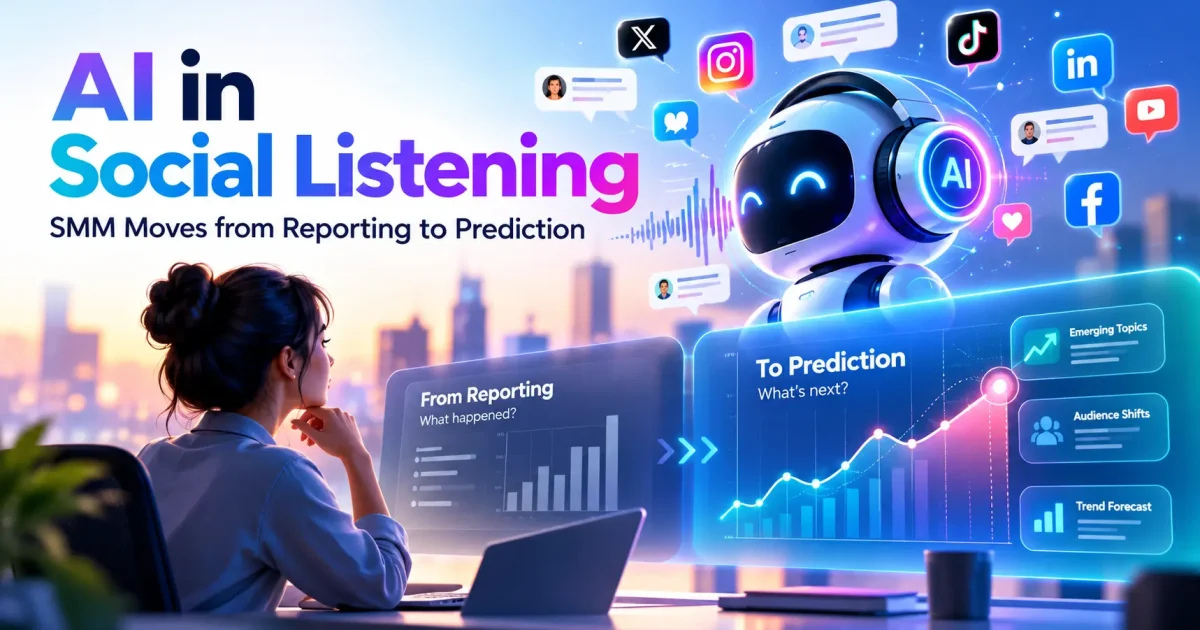
AI in social listening is moving social media marketing from reporting to prediction by helping brands identify emerging conversations, sentiment shifts, unusual activity, customer concerns and early signals of trends before they become obvious. Instead of only explaining what happened last week or last month, marketers can use AI-powered listening to decide what may require attention next and respond faster.
Traditional social media reporting looks backwards. Marketers collect impressions, engagement rates, follower growth, clicks, comments and campaign results. Those numbers are useful, but they mainly explain what has already happened.
AI social listening changes the conversation. Instead of asking only, “How did our campaign perform?”, brands can start asking questions such as-
“What are customers beginning to talk about?”
“Is sentiment around this issue changing?”
“Which topic is gaining momentum?”
“Could this complaint develop into a larger problem?”
The shift matters because social media moves quickly. By the time a trend appears prominently in a monthly report, the best opportunity to respond may already have passed.
AI does not predict the future with certainty. What it can do is analyze large volumes of online conversation quickly, detect patterns that humans may miss and surface signals that deserve closer attention. That is turning social listening from a reporting tool into a more proactive source of marketing intelligence.
What Is AI in Social Listening?
AI in social listening is the process of using artificial intelligence to collect, organize and analyze conversations taking place on social platforms and other online sources. Traditional social monitoring usually focuses on direct mentions, comments, tags and keywords.
Social listening goes further.
It checks for patterns across different social media conversations. It tries to see what people think and say. It then watches for topics that start to emerge. It watches for small shifts in how people think over time. Using AI can speed up this work. It can sort through large piles of unorganized text and help with tasks like these-
• Sentiment analysis
• Topic grouping
• Finding new themes as they appear
• Following what people say about rivals
• Spotting customer complaints and hard spots
• Noting how the brand is viewed
• Watching for sudden jumps in mentions
• Collecting frequent questions
• Tracking what the audience cares about
With this, marketers get more useful context than they would from a simple page that only shows likes and shares.
Why Traditional Social Media Reporting Has Limits
Reporting remains important to social media content creation. Businesses need to know whether a campaign achieved its goals. But the problem comes when reporting becomes the final destination. Suppose a brand discovers at the end of the month that negative comments about one product feature increased significantly. That information is useful.
But what if the brand could have detected the increase during the first few days?
It could investigate the issue, respond to customers, update messaging, or alert the relevant internal team before the conversation became much larger. So, traditional reporting often tells you, “What happened?” But better social intelligence can also explore, “Why is it happening?” and increasingly, “What appears to be developing next?”
That difference can make social data more useful for everyday decisions.
How AI Is Moving Social Listening Toward Prediction
1. Detecting Emerging Trends Earlier
Trends always begin small with smaller groups of people discussing a topic, phrase, concern, product, or behavior. AI can analyze the volume and momentum of conversations and help identify unusual growth.
Say the talk about a particular skincare ingredient starts to grow on TikTok, Instagram, forums and reviews. A beauty brand might be able to grab that movement before it’s a hot topic. It could then investigate whether the trend fits its audience, products, or upcoming content calendar.
The advantage is not knowing exactly what will become viral. It is seeing promising signals earlier.
2. Identifying Changes in Customer Sentiment
Mention volume alone does not tell the complete story, because a company may suddenly receive thousands of mentions because people love a campaign or because something has gone wrong. But AI-powered sentiment analysis helps separate positive, negative and neutral conversations while looking for changes over time.
Imagine positive sentiment around a new product gradually declining. Such a move might merit watching, even if sales overall are healthy. Marketers can probe the reason before the next quarterly customer survey or campaign review. This makes social listening a useful early-warning system.
3. Spotting Reputation Risks Before They Escalate
Social media crises often start with one complaint that gets shared. Similar experiences appear in the comments. A creator posts about the issue and suddenly the conversation expands. AI social listening can help detect unusual increases in negative mentions, repeated complaints or unexpected changes in conversation patterns.
Of course, not every negative comment represents a crisis. You need to apply sound human judgment to differentiate which comment can potentially blow up.
However, marketers can receive an early signal in such a case with AI social listening. This way they can decide whether something deserves investigation instead of discovering the issue only after it has already attracted widespread attention.
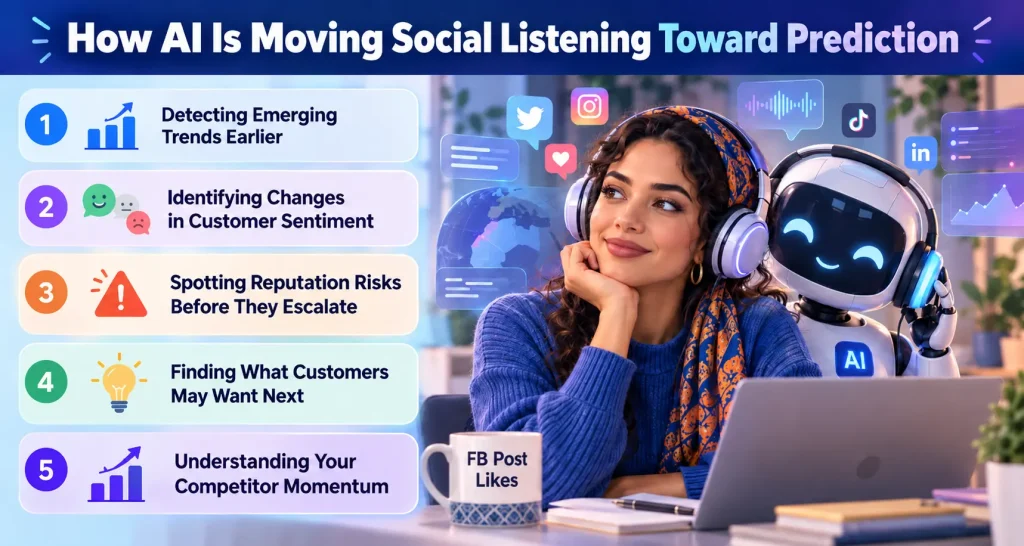
4. Finding What Customers May Want Next
People constantly talk about what they dislike, wish existed, cannot find, or want brands to improve. Those conversations contain valuable information. For example:
“I love this product, but I wish it came in a smaller size.”
“Why doesn’t anyone make this for beginners?”
“I need something that works with…”
When hundreds or thousands of similar conversations appear, AI can help group them into themes.
This information can influence marketing messages, product positioning, content topics and even product development. Rather than relying only on formal surveys, brands gain another source of ongoing customer insight.
5. Understanding Your Competitor Momentum
Social listening isn’t just about your brand. Standard artificial intelligence can be used to understand conversations around competitors, products, campaigns and larger market categories. However, that does not mean copying the competitor’s strategy. Instead, the insight can reveal changing customer expectations. So, brands can ask-
• What are people appreciating?
• What frustrates them?
• Which messages appear to resonate?
• What questions remain unanswered?
These signals can help businesses make better decisions about positioning and communication.
How Marketers Can Use Predictive AI in Social Listening Effectively
AI in social listening should start with specific business questions rather than collecting data simply because it is available.
For example-
• Are customer concerns around our category changing?
• Which new topics are appearing among our target audience?
• Are competitors gaining positive attention for something new?
• Is negative sentiment around our brand increasing?
• Which customer questions are becoming more common?
Then compare AI generated insights with other information.
You get insights with website searches, customer support conversations and sales data. Even search trends, surveys and campaign analytics can provide valuable additional context.
This combination is stronger than relying on any single source.
Human Judgment Still Matters
AI can process more social conversation than a marketing team could realistically read manually. But what it cannot fully understand is every cultural reference, joke, customer motivation, business priority or strategic implication in social media content. So, marketers need to validate what AI surfaces.
Ask whether the signal is relevant to your audience. Check the original conversations. Look at whether the pattern appears across multiple sources rather than a handful of posts. Most importantly, avoid treating an AI generated insight as an automatic instruction. This will guide in better decision making.
Better data should support better human decisions, not remove humans from the process.
Final Thoughts
Social media marketing is gradually moving beyond retrospective dashboards. So, reporting may tell brands what already happened. But AI in social listening can help them understand what is developing now and what may deserve attention next.
That can mean detecting an emerging customer concern or noticing a shift in sentiment. It may even span identifying an early trend or understanding competitor momentum.
However, the real advantage is not perfect prediction. It is earlier awareness.
Brands that identify meaningful signals sooner have more time to investigate, plan, respond and adapt. In a social environment where conversations can change quickly, that extra time can make social listening far more valuable than another monthly report.
FAQs
What is AI in social listening?
AI in social listening means using machine learning tools to study online talk about a company, rivals, products, customers and industry news. It work with a large volume of data to spot changing sentiment, common topics and early signals that something is gaining attention.
Can AI in social media predict trends?
It can flag early clues that a topic is starting to catch on. Still, that does not guarantee the topic will grow into a real trend. AI is more reliable for finding new shifts, odd patterns and sudden changes. They help marketers check what is really going on and choose next steps.
How is AI in social listening different from social media monitoring?
Social media monitoring often focuses on single mentions, tags, comments and messages. Brands can then respond to them. But AI in social listening looks broader across what people are saying. It uncovers shared themes and sentiment changes. That can guide marketing choices.