Disclosure and Ethics: Role of Virtual Influencers using AI in Social Media Marketing
Virtual influencers already out-engage human ones with AI in social media marketing. Research published in Hype Auditor found that AI-generated influencers can achieve engagement rates up to three times higher than their human counterparts. This number explains why so many brands are experimenting with digital personas on social media. It also raises the stakes for getting disclosure and ethics right.
If you are weighing a virtual influencer for your next campaign on Instagram or Facebook, this is not just a creative choice with AI in social media marketing. It is a compliance and trust decision. Here is what to know before you sign off on a partnership.
What Counts as a Virtual Influencer
A virtual influencer is a computer-generated character built using CGI, 3D modeling and often AI, designed to look and act like a real social media personality. They post photos, star in videos and partner with brands, just like human influencers do.
Researchers generally split them into three types:
– Human-like virtual influencers (HVIs), designed to closely resemble real people;
– Anime-like virtual influencers (AVIs), animated or cartoon-style characters clearly presented as digital;
– Non-human virtual influencers (NVIs), animals, objects, or fantasy characters with no attempt to pass as human.
Lil Miquela is one of the best-known examples of AI in social media marketing. She has around 2.3 million Instagram followers and has partnered with brands including Prada, Calvin Klein and Samsung. Imma, Japan’s virtual model, has worked with Dior, Nike, and Porsche Japan. Both openly describe themselves as virtual, which matters more than it might seem.
Why This is an Ethics Issue, Not Just a Marketing One
The appeal for brands is obvious. A virtual influencer with AI in social media marketing does not age, does not get tired and can be reshaped instantly for a new campaign. This level of control is exactly why more companies are exploring them.
It is seen that influencer marketing offers the biggest advantages to the brands, while the benefits for consumers are often limited. For instance, when a follower does not know a “person” they are engaging with isn’t real or does not know who is running the account, it is where the trust starts to erode.
This issue becomes more serious with human-like virtual influencers. When a digital character is designed to be mistaken for a real person, followers can end up crediting it with authenticity and independent judgment it does not actually have. This misplaced trust can shape purchase decisions in ways a fully transparent ad wouldn’t.
There is also a question of accountability with AI in social media marketing. A virtual influencer has no autonomy. Every post, opinion and partnership is decided by the people behind it. So, when something goes wrong, whether it is a misleading claim or a tone-deaf campaign, the responsibility sits entirely with the human team, not the character. Now this is a different accountability structure than working with a real spokesperson, and it needs to be treated that way internally.
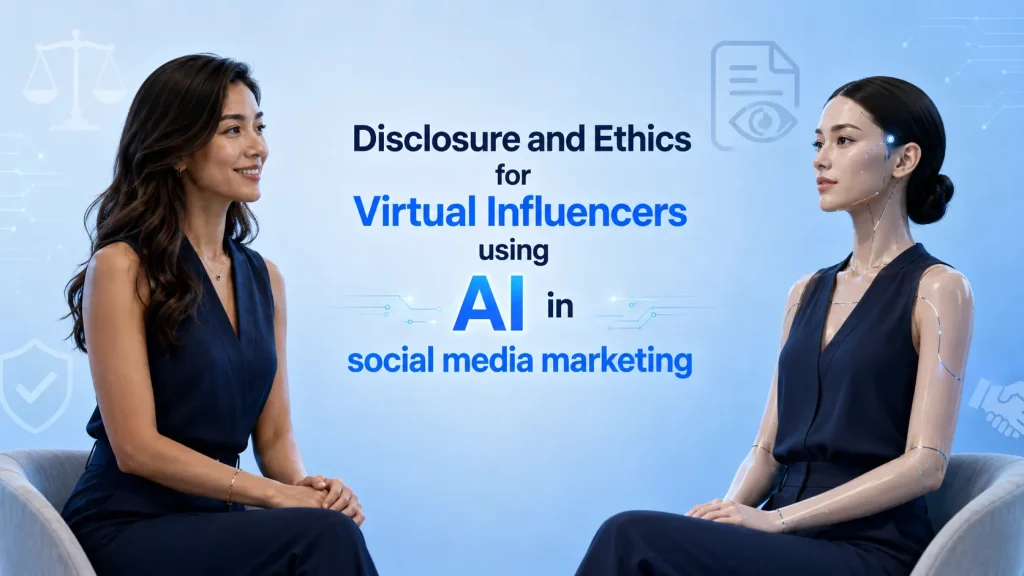
The Disclosure Rules Have Caught Up
For a while, virtual influencers operated in a gray area. This is no longer the case in the US.
The Federal Trade Commission updated its Endorsement Guides to expand the definition of “endorser” to include anything that “appears to be an individual, group, or institution.” This wording was written specifically to bring virtual influencers, fabricated personas and non-existent entities under the same disclosure rules as human influencers when using AI in social media marketing.
In practice, this means:
-Any material connection between a brand and a virtual influencer’s account must be disclosed
-Disclosures need to be “clear and conspicuous,” sitting directly on or beside the endorsement rather than buried in a bio
-Video content needs the disclosure visible within the video itself, and
-Brands that license a virtual influencer carry their own disclosure obligation. Disclosure on the influencer’s “home” account isn’t enough to cover a one-off sponsored post elsewhere.
Since October 2024, the FTC has also finalized rules banning fake reviews as well as testimonials, with civil penalties that align with the violation. Regulators have made clear that AI-generated content used to fabricate endorsements or reviews is an enforcement priority, alongside health, wellness and financial product claims.
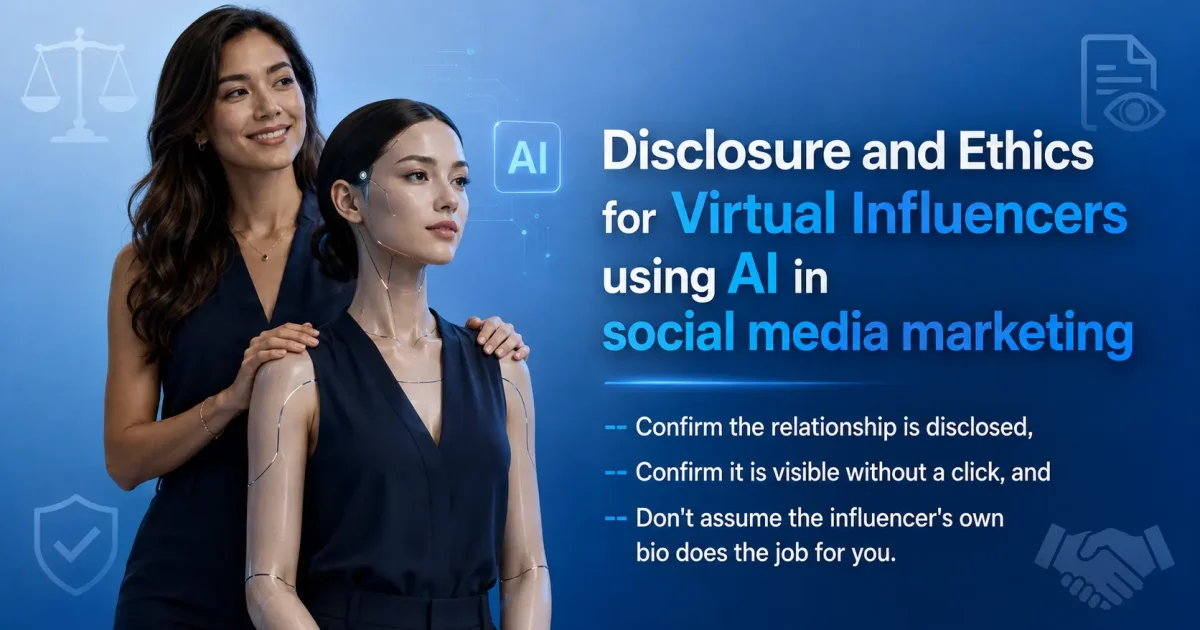
If your business is considering a virtual influencer partnership, the compliance checklist looks like it would for a human creator: confirm the relationship is disclosed, confirm it is visible without a click, and don’t assume the influencer’s own bio does the job for you.
Building a Trust-First Approach with AI in Social Media Marketing
Complying with the legal laws is the minimum expectation, and it is only the first step. A few habits separate brands that build trust from those that just avoid a fine:
1. Be upfront about the “who,” not just the “what”
Followers increasingly want to know which team or agency is behind a virtual influencer’s account. Naming the studio behind a persona, even briefly, does more for credibility than a generic “sponsored content” tag when it comes to using AI in social media marketing.
2. Match the character type to the message
If a virtual influencer sells something that is linked to physical experience, like the results of skincare or fitness outcomes, a hyper-realistic human-like persona can create the impression that it actually used the product. Some companies purposely choose characters in these categories that are more obviously animated to avoid the confusion.
3. Watch for parasocial dynamics
Followers form the same one-sided attachment to virtual influencers as they do with real ones, even knowing the character is not real. This is a powerful asset, but it deserves the same care you would apply to any spokesperson relationship, especially with younger audiences.
4. Document your review process
Because a virtual influencer has no independent judgment, every claim it makes is one your team approved. Keep a clear record of who signs off on scripts as well as claims.
5. Reassess as the technology shifts
As virtual influencers grow more autonomous, generating content as per trending topics or AI-driven decisions, the question of who is responsible for a problematic post gets harder to answer. Review periodically how much autonomy your system has, and keep a human accountable for what it publishes.
To Conclude
Virtual influencers aren’t a passing trend with AI in social media marketing. They offer real advantages in the form of consistency, control and often stronger engagement than human creators deliver. But the same qualities that make them appealing, such as no scandals and no unpredictability, also mean your business carries full responsibility for every word they “say.”
Disclosure is not a box to tick after the creative work is done. It is part of how you earn the right to use this format at all. Brands that treat transparency as part of the campaign and not a footnote to it will keep audience trust as this space keeps evolving.
FAQs
1. Do virtual influencers need to disclose brand partnerships like human influencers do?
Yes. The FTC’s revised Endorsement Guides broadens the definition of “endorser” to encompass anything that looks like an individual, group or institution, including virtual influencers. The same clear-and-conspicuous disclosure standard applies.
2. Who is legally responsible if a virtual influencer makes a misleading claim?
The company or agency that owns the account. Virtual influencers have zero independent decision-making ability. So, accountability sits with the humans managing the persona and approving its content.
3. Are virtual influencers actually more effective than human influencers?
Studies show engagement rates up to three times higher, often because of novelty as well as tightly controlled content. Effectiveness still depends on the audience and the goal. They also tend to resonate better with younger, digitally native audiences over older demographics.
4. Should we use a realistic or an obviously animated virtual influencer with AI in social media marketing?
It depends on the message. Realistic, human-like personas suit fashion or lifestyle content but carry more risk of misleading audiences on claims tied to physical experience, like health products. Animated or non-human characters reduce that risk while still driving strong engagement.