AI in B2B marketing: How It Redefines Social Selling
Consider this statistic: 67% of B2B buyers now say they would rather complete their purchase journey without ever talking to a salesperson, according to Gartner’s 2026 survey of 646 B2B buyers. And 45% of those buyers already used AI somewhere in their last purchase decision. This makes AI in B2B marketing important.
If your marketing strategy still revolves around getting a sales representative on a call or landing a LinkedIn connection, it may be time to rethink your approach. Social selling was built a generation of B2B playbooks. But buyers have moved on faster than most teams have. AI in social selling is not replacing traditional approaches because it is trendy; it is replacing it because buyers now research, vet and shortlist vendors before anyone from your team is even aware of their existence.
The goal today is not about chasing another tool to market your services and offerings. It is about understanding where AI actually creates an edge in B2B marketing today, and where it doesn’t.
Why social selling alone isn’t enough anymore
Social selling worked when buyers needed a human to walk them through options. A well-timed LinkedIn message could open a door that content alone couldn’t.
This door is closing now. Buyers now weigh an average of seven information sources before deciding, and most of this evaluation happens with no seller involved. By the time a rep gets a meeting, the buyer is no longer seeking basic information. They have already read the reviews, compared vendors and formed an opinion.
This changes marketing’s job. It is no longer just about getting noticed on social feeds. It is about making sure your content as well as messaging shows up wherever buyers are researching. This includes search, review sites, AI assistants, industry forums and social media. And all of these channels play a key role, rather than relying on just one.
What AI actually does differently
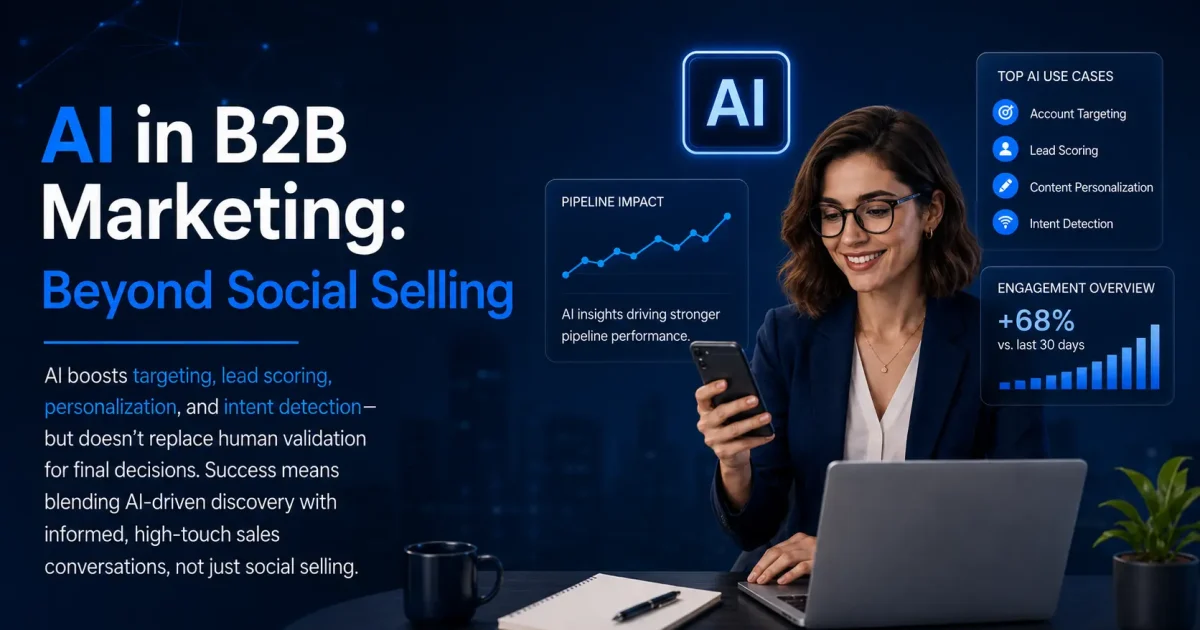
AI in B2B marketing is not one tool doing one job. It is a set of technologies solving different problems, and it helps to separate them clearly.
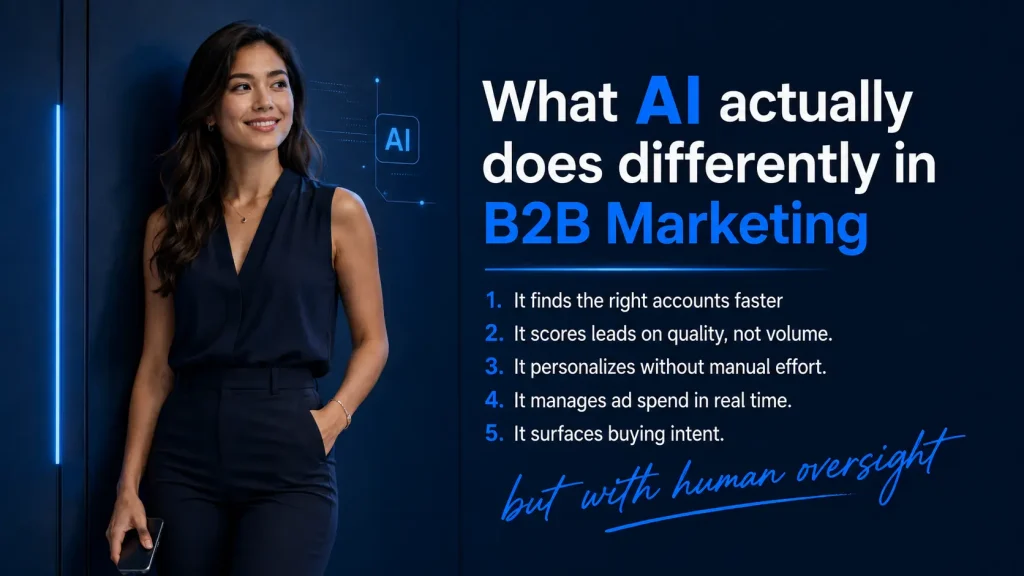
1. It finds the right accounts faster
AI tools analyze your existing customer data. This includes your company size, industry, tech stack and buying signals. Then, it surfaces more accounts that look like your best customers. This is a real upgrade from broad targeting by job title or industry alone, which wastes spend on people who were never going to buy.
2. AI in B2B marketing scores leads on quality, not volume
Traditional lead generation optimizes for how many names you collect. AI-based lead scoring cross-checks which leads have actually converted in the past and then it ranks new leads by how closely they match that pattern. As such, the sales team receives fewer but high-quality leads.
3. It personalizes without manual effort
AI can adjust website content, email sequences as well as ad creative based on a visitor’s company or role, without a marketer manually building ten versions of one campaign.
4. It manages ad spend in real time
The marketer doesn’t log into the ad platforms and manually shift budget; instead, AI systems are constantly testing variations and shifting spend to what is working.
5. It surfaces buying intent
Some platforms track behavior across the web. These include content downloads, review site visits and search activity. All of these help flag when an account is actively researching a solution like yours before they have filled out a form.
This doesn’t replace strategy. It simply automates routine tasks, giving your team more time to focus on strategic decisions like positioning, messaging as well as targeting the right customers.
The part everyone gets wrong: AI in B2B marketing doesn’t replace the human moment
Here is where the nuance lies. Gartner’s research also found that 69% of buyers still turn to a salesperson to validate what AI told them. By 2030, Gartner expects 75% of buyers will actually prefer buying experiences that prioritize human interaction over AI-only paths.
Read it carefully. Buyers want to research alone, but they don’t want to decide alone. AI excels at gathering information. It falls short, however, at giving someone the confidence to sign off on a six-figure contract. This confidence still comes from a person, perhaps a representative, a case study from a similar company or a peer review that reads as credible.
For CxOs, this means AI in B2B marketing should sharpen the early research phase, not eliminate the human touchpoint. The businesses getting this right use AI to handle discovery and qualification, then make sure the human conversation that follows is genuinely useful. And such conversations are not generic demos, but one informed by everything the buyer already researched.
Where to focus if you are leading marketing or the business
If you are a business owner or CxO deciding where to invest, a few priorities matter more than others right now.
1. Invest in content that works without a salesperson in the room
Comparison pages, transparent pricing, case studies with real numbers and independent reviews now do the job a representative used to do in discovery calls. If buyers can’t find answers without booking a meeting, you are losing them earlier than you think.
2. Use AI in B2B marketing to identify intent, not just contacts
It is counterproductive to maintain a list of 10,000 leads, but none of them are actively seeking a solution. So, consider using tools that flag the actual buying signals without expanding your database.
3. Keep humans in the loop for validation
Avoid automating the parts of the buying process where customers are looking for personal guidance as well as reassurance, especially when they are about to make a decision.
4. Track the full picture, not vanity metrics
AI makes it possible to connect ad spend and content engagement directly to closed revenue. This provides far more valuable insights than simply tracking likes and shares on social media.
The bottom line
Social selling isn’t dead, but it is no longer the whole strategy. Buyers are doing most of their homework independently, often with AI tools of their own, before your team knows they are in market. This means marketing should provide informative content during the research stage and the sales team must offer personal guidance when buyers decide to reach out.
Get this balance right in AI in B2B marketing, and you won’t just adapt to the way B2B buying has changed. You will stay ahead of competitors who still rely on LinkedIn outreach to generate leads. Stays tuned to FBPostLikes for more insights on the impact of AI in social media marketing.
FAQs
1. Does this mean social selling is no longer worth doing?
No. It is still useful for visibility and relationships, but it can’t be the whole strategy. Buyers spend most of their evaluation time elsewhere either reviewing sites, searching, or doing independent research. So, your presence needs to cover them, too.
2. How much of the buying journey happens without sales contact?
Estimates vary by source, but multiple studies place independent research at well over half the journey, with many buyers preferring little to no rep contact until late in the process. The direction is consistent: less contact early, more informed conversations later.
3. Is AI in B2B marketing only useful for large companies with big budgets?
Not necessarily, but returns scale with data. AI tools work ideally with enough historical data to learn from. And while it makes more sense to heavily automate ads once you have a larger budget, smaller companies can still gain from lead scoring and personalization.
4. What’s the biggest mistake companies make adopting AI in B2B marketing?
Treating it as a replacement for strategy rather than support for it. AI in B2B marketing handles research, targeting and repetitive execution well, but it cannot define your positioning or interpret nuance in a high-stakes conversation. Companies relying on AI alone, without a clear market point of view, tend to see limited results.