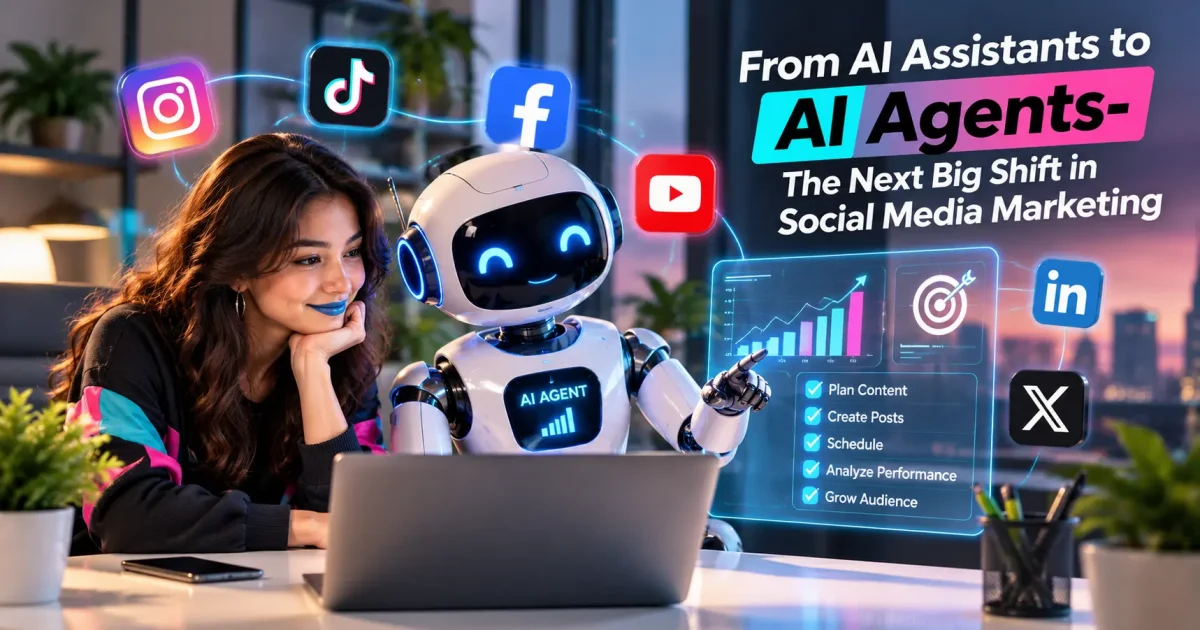
From AI Assistants to AI Agents- The Next Big Shift in Social Media Marketing
Agentic AI in social media marketing is moving beyond simple assistance. Until recently, most marketers used AI to help with isolated tasks such as generating captions, summarizing reports, suggesting post ideas, or rewriting content.
Agentic AI in social media go further. Instead of simply answering a prompt, they can plan, connect with tools, monitor activity, complete multi-step tasks and take action within defined limits.
That shift could change how social media teams work. The future may not be about marketers asking AI to write one post at a time. It may be about giving an AI agent a goal and letting it coordinate several steps needed to achieve it.
What Is the Difference Between an AI Assistant and an AI Agent?
An AI assistant usually responds to a direct request.
You might ask-
“Write five Instagram captions.”
“Summarize this analytics report.”
“Give me ideas for next week’s Facebook posts.”
The assistant completes the task and waits for the next instruction.
Agentic AI in social media works differently.
It can take a broader objective, break it into smaller steps, connect with relevant tools and continue working toward the goal. For example, instead of asking AI to create one post, a marketer might eventually say- “Review our best-performing Instagram content from the last 30 days, identify three strong themes, create a week’s content plan and flag which posts should be repurposed.”
The Agentic AI in social media could handle several stages of that workflow rather than only one.
Meta’s Muse is a good example of this shift. Meta describes Muse as a personal AI agent that can plan, use connected apps, complete tasks and continue working until it needs approval for a sensitive action.
Why Agentic AI in Social Media is Important
Social media management involves far more than writing posts. Marketers constantly move between-
- Content planning
- Analytics
- Customer questions
- Scheduling
- Community engagement
- Trend monitoring
- Reporting
- Campaign optimization
- Creative production
Most AI tools currently help with one part of this process. AI agents could connect several of these activities. That is the real opportunity. Rather than saving five minutes on a caption, an agent could potentially save hours across an entire workflow.
HubSpot’s 2026 research already shows AI embedded deeply into social workflows, with 73% of marketers using AI in content-related processes. The next shift is toward tools that do more than generate content and begin coordinating work.
Here is how agentic AI in social media can deliver business value.
1. Agents Can Monitor Social Performance Continuously
Traditional analytics usually require someone to open a dashboard, review results and decide what matters. An AI agent can potentially monitor performance continuously. It could identify-
- Sudden engagement changes
- Posts outperforming normal benchmarks
- Declining reach
- Unexpected audience growth
- Repeated customer questions
- New content patterns
Instead of waiting for a weekly report, the marketer could receive a useful alert when something important changes. The difference is subtle but powerful.
An assistant explains the data when asked.
An agent watches the data and tells you when attention may be needed.
2. AI Agents Can Connect Analytics With Content Planning
Social media teams often separate reporting from creation. One person checks analytics. Another creates the content calendar. Someone else writes captions. Agentic AI in social media can connect these stages.
For instance, it may notice that product comparison Reels consistently outperform generic promotional posts. It could then recommend more comparison content, identify suitable existing material and prepare draft ideas for the next calendar. This creates a feedback loop-
Performance → Insight → Recommendation → Content Plan
That is much more valuable than an AI tool that only produces isolated captions. Meta has already started moving in this direction. Its Meta One plans are expected to include tools that analyze Instagram insights and help creators brainstorm content ideas based on those results.
3. Customer Conversations Could Become More Automated
Agentic AI in social media may also change how businesses handle customer engagement. Meta’s Business Agent can already answer business-specific questions, make product recommendations, book appointments, qualify leads and hand conversations over to a human when needed. It is also expanding into Instagram.
The goal is not simply to respond with a canned answer by a chatbot. An agent can understand context, use business information and move the conversation toward a useful next step. For social media teams, that could mean fewer repetitive responses and faster support. But human involvement still matters. This is especially true for complex or sensitive situations.
But yes, routine interactions can increasingly be handled automatically.
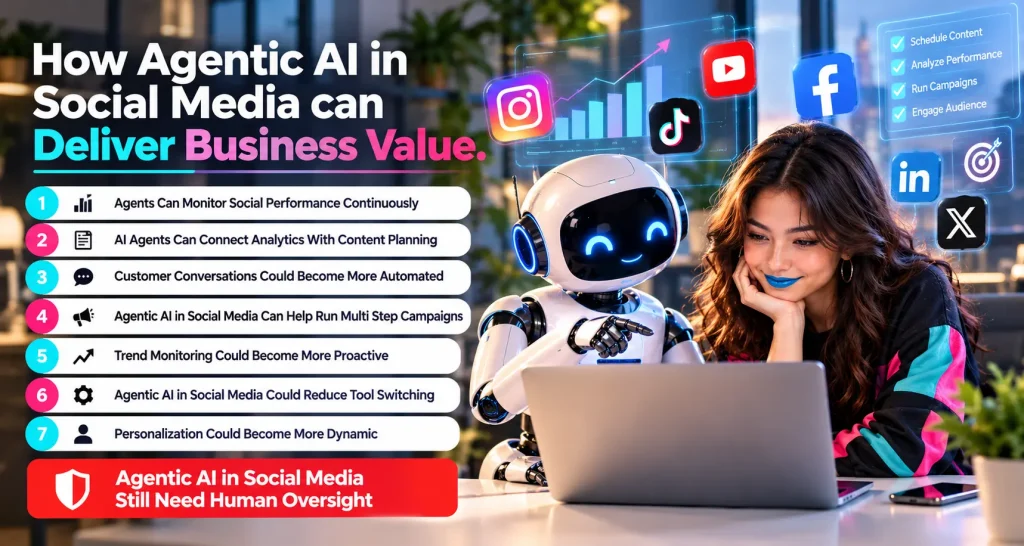
4. Agentic AI in Social Media Can Help Run Multi Step Campaigns
Campaign management involves many connected tasks. According to my experience, a marketer may need to-
- Analyze past campaign performance
- Identify the target audience
- Develop campaign ideas
- Create content variations
- Schedule posts
- Monitor results
- Adjust based on performance
An AI assistant can help with individual parts. But the AI agent can potentially coordinate the full sequence. Salesforce, for example, now describes agentic marketing systems as AI teams that help marketers build pipeline, create content, run campaigns and optimize customer experiences as behavior changes.
This does not mean marketers disappear.
It means their role can shift from manually executing every step to setting goals. It also means setting boundaries, reviewing output, making strategic choices.
5. Trend Monitoring Could Become More Proactive
Social trends move quickly. By the time a marketer notices a topic manually, the opportunity may already be crowded. Agentic AI in social media could be used to continuously monitor conversations and highlight relevant trends.
For instance, an agent may find that a new phrase is gaining momentum or a competitor is getting unusual attention. It may happen that one specific complaint from customers is on the rise or a topic is becoming popular in a niche audience
The marketer can then decide if the trend is relevant. This is particularly useful when combined with social listening. The agent does not have to perfectly predict the future. It just needs to catch the meaningful signals earlier.
6. Agentic AI in Social Media Could Reduce Tool Switching
One of the biggest frustrations in social media marketing is moving between platforms.
A typical workflow might involve-
- X
- TikTok
- Analytics software
- Scheduling tools
- CRM
- Cloud storage
- Project management software
AI agents are increasingly being designed to work across multiple tools. Meta’s Muse, for instance, can connect with apps and services, while Muse for Small Business can connect with Instagram professional analytics, Facebook Pages and Meta ad accounts.
That could reduce repetitive copying, exporting and switching between dashboards. This way, the more connected the agent becomes, the more useful it becomes for real workflows.
7. Personalization Could Become More Dynamic
Predefined audience segments will dictate customization success. AI agents could make this more flexible. You need not simply decide that one audience sees one message and another audience sees something else. Instead, agents could continuously adapt recommendations based on behavior. They might observe the following changes-
- New customer interests
- Different response patterns
- Changing engagement habits
- Changes in buying intent
This will make social campaigns more responsive.But it also poses important issues of privacy, data access and transparency. Better personalization only works when the data is reliable and the system is used responsibly.
Agentic AI in Social Media Still Need Human Oversight
The biggest mistake would be assuming AI agents can run social media completely independently.
They cannot.
Current systems for agentic AI in social media still need clear goals, good data, appropriate permissions and human review. HubSpot notes that many current social tools are still closer to advanced assistants than fully autonomous agents. True agents that listen, learn and act independently are emerging, but the technology is still developing. Marketers still need to decide-
- What the brand should say
- What should never be automated
- When human approval is required
- How sensitive customer data is handled
- Which actions need escalation
- What counts as acceptable risk
The technology may become more autonomous. But the accountability does not.
What Marketers Should Do Now
Businesses do not need to wait for fully autonomous agents before preparing. They can start by identifying repetitive workflows. Ask-
- Which tasks consume time every week?
- Which steps require the same information repeatedly?
- Where does your team keep switching between tools?
- Which decisions could benefit from faster analysis?
Then document those workflows clearly. The more structured your processes are, the easier it will be to hand suitable parts of them to AI agents later. Marketers should also improve data quality. 81% marketers trust AI to respond to customers at scale. But disconnected or irrelevant data remains a major obstacle.
Agents can only work well with the context they receive.
In 2027, The Marketer’s Role Will Change, Not Disappear
Agentic AI in social media are likely to automate more execution. That does not make marketers less important. It makes strategic judgment more important. Someone still needs to understand the audience, shape the brand, decide what success looks like and determine whether the agent’s output makes sense.
The strongest marketers may spend less time manually producing individual posts and more time on-
- Strategy
- Creative direction
- Audience insight
- Brand positioning
- Experimentation
- Quality control
- Customer understanding
That is a meaningful shift.
Final Thoughts
AI assistants made social media work faster. Agentic AI in social media could make it more connected. The move from generating isolated captions to monitoring performance, coordinating workflows, managing conversations and acting across tools represents a much bigger change.
The most important question is not whether Agentic AI in social media will replace social media marketers. It is how much routine execution marketers will choose to hand over. Used well, agents could reduce repetitive work and give teams more time for strategy, creativity and customer understanding.
But the best results will still depend on human judgment. AI agents can take action. But humans still need to decide what actions are worth taking.
FAQs
What is an agentic AI in social media marketing?
An AI agent can monitor, plan and complete connected marketing tasks across tools, rather than simply answering individual prompts like a traditional AI assistant.
Will AI agents replace social media managers?
No. AI agents can automate repetitive execution. But the strategy and the brand judgment is still from marketers. Human efforts are also needed for creative direction and risk management.
How can marketers prepare for agentic AI in social media now?
Document repetitive work process, enhance data quality, outline approval procedures and determine tasks that can be automated while maintaining brand voice, accuracy, and customer trust.