AI Search for Social Discovery- Why Social Posts May Matter Beyond the Feed
A few years ago, the path to discovering content on social media was fairly predictable. Users opened an app, scrolled through a feed and interacted with whatever appeared in front of them. Whether a post succeeded or failed depended largely on platform algorithms, timing, audience engagement and a creator’s existing reach. But this model is beginning to evolve with AI search for social discovery.
As AI-powered search experiences become more common, social media content is increasingly being surfaced outside the platforms where it was originally published. Users are turning to AI assistants, answer engines and conversational search tools for information search. Here, they create new pathways to discovery that do not always begin with a traditional social feed.
For brands, creators and marketers, this shift in AI search for social discovery raises an important question- what happens when social content starts being discovered by people who never opened the platform in the first place?
How AI Search for Social Discovery is Evolving in 2027
Traditional search engines were designed to return lists of links. Users clicked through multiple sources, compared information and formed their own conclusions.
AI search for social discovery introduces a different experience.
Instead of simply presenting links, many AI powered tools like ChatGPT summarize information. They also answer questions directly and fan out to source content from multiple sources. Users can ask conversational questions and receive responses that reduce the amount of research required.
This behavioral shift matters.
Someone researching the best software for a startup, local restaurant recommendations, fitness advice, or a product comparison may encounter information influenced by discussions that originated on social platforms. In many instances, real experiences, creator commentary, customer reviews and public conversations provide context that traditional website content cannot always match.
The result is that content is beginning to influence AI search for social discovery in ways that extend beyond likes, shares and platform engagement metrics.
Why Social Media Posts Are Becoming Relevant Beyond the Feed
Social platforms contain an enormous volume of first-hand observations. People document purchases, test products, share professional experiences, offer tutorials, review services and discuss industry developments. While these posts were originally created for social audiences, they often contain information that others find useful long after publication.
That has always been true to some degree. What is changing is how that information is now shown via AI search for social discovery.
A product review published on a social platform may no longer depend entirely on platform visibility. A creator’s detailed explanation, case study or experience can contribute to broader information ecosystems. Using this, AI tools are identifying patterns, extracting insights and surfacing useful perspectives.
This is especially relevant for sectors where authenticity influences buying decisions. Users frequently trust practical experiences, demonstrations and real-world testing more than polished marketing claims.
In that environment, social content becomes more than content. It becomes a searchable source of perspective.
How AI Search Could Influence Social Media Visibility
Not every post is equally likely to benefit from AI-driven discovery.
Content that contributes useful information tends to have a different profile than a post created exclusively around entertainment or trends.
Tools using AI search for social discovery are typically far more interested in content that helps answer questions, explain concepts, compare options, or provide practical context.
A creator discussing lessons learned while launching a business may have long-term discovery value. A software consultant breaking down common implementation mistakes may as well. An industry expert may share experiences from a real project. This offers information that remains useful beyond a single news cycle.
What Formats Help with AI Search for Social Discovery?
Certain content formats naturally align with AI search for social discovery.
Detailed educational posts
They they explain topics clearly and address specific problems. Tutorials, workflows and industry commentary are some examples. Even product comparisons, case studies and experience based insights all fall into this category.
Posts that include unique observations
For example, a marketer explaining why a campaign succeeded. Or a contractor discusses common project mistakes. Also a founder can document operational lessons. They offer context that cannot easily be replicated elsewhere.
How to Optimize Content to Ensure AI Search for Social Discovery
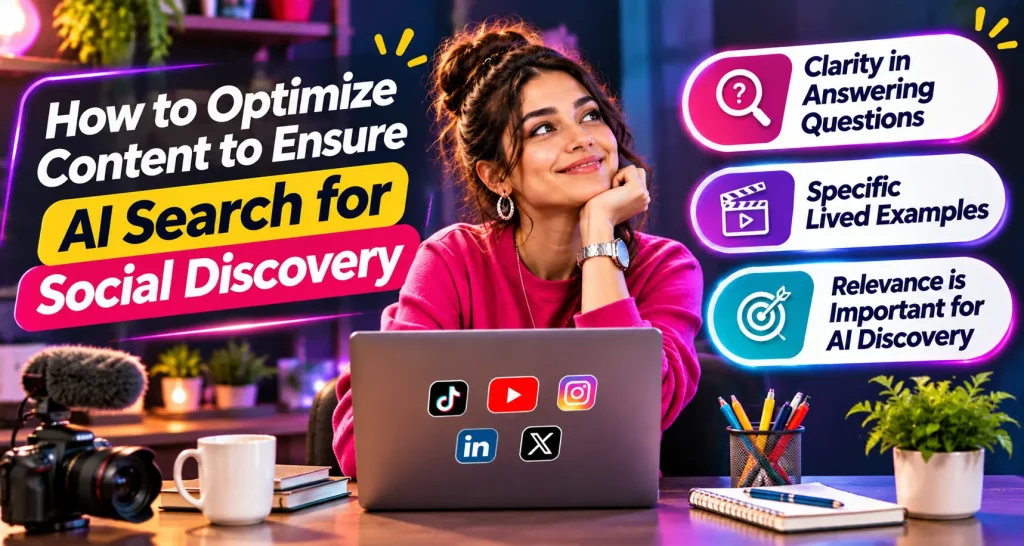
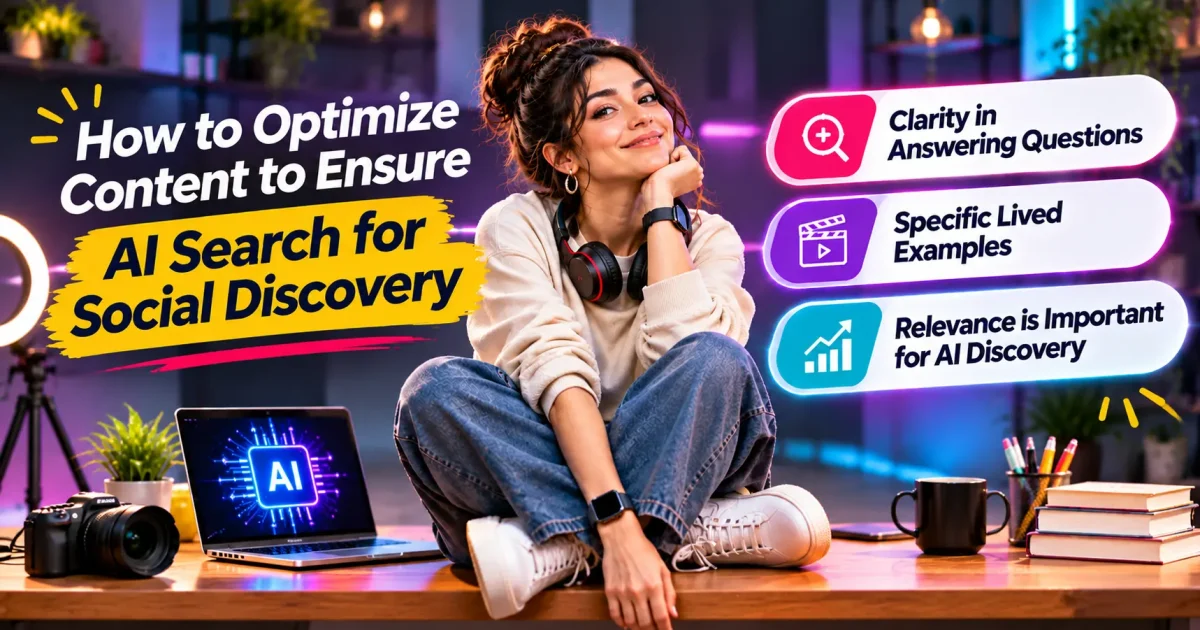
There is a temptation to treat AI discovery as another optimization exercise. However, this mindset can lead to content becoming overly engineered. Clarity is the first step toward a more sustainable road. Posts should present ideas clearly to make it easy for readers to know what problem is being solved. Strong topic focus often matters more than attempting to include keywords unnaturally.
Specificity helps as well. General statements are awfully common across social platforms. Detailed observations, examples and practical insights are far less common and therefore more valuable.
Creators who consistently explain, teach, document, or analyze topics often produce content that remains discoverable because it retains relevance.
In many cases, the same qualities that make content useful to people make it more useful within AI-driven discovery environments.
Why Social Media Engagement Still Matters
None of these tactics in AI search for social discovery means engagement becomes irrelevant.
Social platforms still determine distribution, community development, follower growth and relationship building. Comments, shares, saves and conversations remain powerful signals because they reveal what audiences genuinely care about.
AI search does not replace those interactions. Instead, it introduces another layer of visibility.
A creator may earn engagement from their existing audience while simultaneously creating content that remains discoverable through future search behaviors. The two outcomes are not competing with one another. They reinforce one another.
Audience response continues to be one of the strongest indicators that content is providing value using AI.
The Future of AI Search for Social Discovery
The line between search, content and social media is becoming less distinct.
Search engines are becoming more conversational. Social platforms are becoming richer sources of information. AI systems are increasingly acting as intermediaries that help users navigate both.
As that convergence continues, social posts may take on a larger role in digital discovery. The content attracting attention will not necessarily be the content that shouts the loudest. More often, it may be the content that informs, explains, documents, or offers a perspective grounded in real experience.
This helps creators target conversions with long term engagement.
Conclusion
Social media discovery is no longer confined to social feeds.
As AI-powered search and answer engines become part of everyday research behavior, valuable social content can influence visibility in ways that were not possible even a few years ago. Educational content, expert perspectives, first-hand experiences and thoughtful analysis may continue reaching audiences long after publication. This is possible through AI search for social discovery.
The brands best positioned for this shift are unlikely to be those producing the highest volume of content. They will be the ones creating content people genuinely find useful, whether it is discovered through a social feed, a search result, or an AI-generated answer.
FAQs
Does AI search for social discovery replace social media platforms?
No. Social platforms remain where communities form, conversations occur and engagement takes place. AI search introduces additional discovery pathways rather than replacing social networks.
What types of social posts can help in AI search for social discovery?
Educational content, tutorials, case studies, expert commentary, product comparisons and experience-driven posts can help. They generally have stronger long-term discovery potential than highly trend-focused content.
Should brands create social content differently because of AI search for social discovery?
Brands do not necessarily need an entirely new strategy. However, creating clearer, more informative and more experience based content is helpful. It improves visibility beyond traditional platform feeds.
Will engagement metrics still matter?
Yes. Engagement still matters. It mirrors audience interest and helps to shape platform distribution tactic. AI driven discovery adds another layer of potential visibility. It does not replace engagement signals.
Can older social posts benefit from AI powered discovery?
Content can retain value over time and even provide value as search queries continue to evolve. Especially, when the content is still relevant and answers current questions.