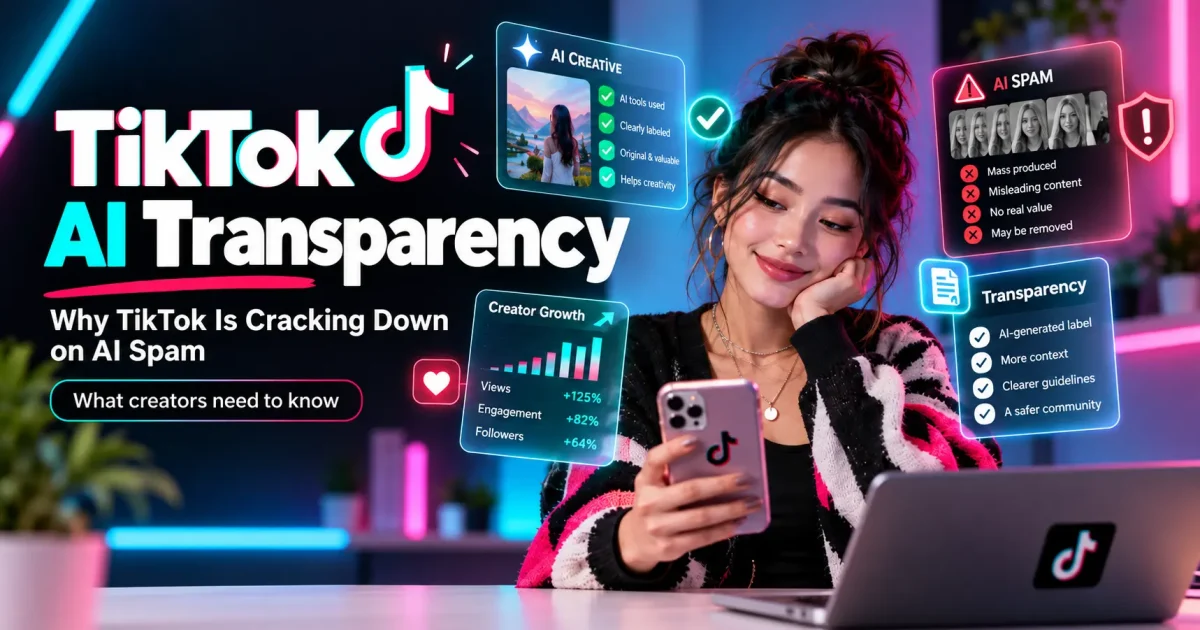
How TikTok AI Transparency Fights Against AI Spam in 2027?
TikTok AI transparency is becoming increasingly important as the platform targets AI spam, expands content labelling and promotes responsible AI use. Creators can still use AI, but originality, disclosure, trust and meaningful human input now matter more than ever.
AI has made it easier than ever to create TikTok videos. A creator can now generate images, edit clips, write scripts, clone voices, create synthetic presenters, or turn one idea into several videos in a fraction of the time it once took.
That convenience also creates a problem. When AI is used to mass-produce low-value videos, copy existing ideas, create misleading footage, or flood popular topics with repetitive content, original creators have to compete with an enormous volume of material.
TikTok is responding by strengthening its approach to AI-generated content, spam detection, labelling and transparency.
In 2026, TikTok unveiled new systems designed specifically to identify accounts pushing AI-generated spam. It is also expanding AI literacy resources, strengthening content-provenance technology and giving users more information and control around AI-generated content.
For creators, the message is not that AI is banned. But it now needs originality and creativity with TikTok AI transparency. So, TikTok continues to develop its own AI-powered creative tools. But the bigger message is that AI should support creativity rather than replace originality, authenticity and transparency.
Why Is TikTok AI Transparency Needed to Fight Spam?
AI-generated content is not automatically spam. A creator might use AI to brainstorm a script, generate a background, clean up audio, produce an illustration, or experiment with a creative concept. But the problem begins when automation is used to manufacture large quantities of repetitive or misleading content.
TikTok says AI can be misused to mass-produce spam that crowds out authentic creators. The platform has therefore begun testing improvements to its detection systems for accounts that appear dedicated to posting AI-generated spam. This fits into TikTok’s broader anti-spam efforts.
The company says it removed more than 86 million fake accounts during the first three months of 2026 alone using its existing systems.
It might eventually help real creators with stronger spam detection with TikTok AI transparency. If TikTok can reduce automated networks and low effort AI content, original creators may face less synthetic competition for attention.
TikTok Is Monitoring High-Risk Topics More Carefully
TikTok’s latest detection tests don’t necessarily target all creators playing with AI for growing their channels. The platform has highlighted accounts producing AI generated spam around subjects that could affect public trust or wellbeing.
These include-
- Politics and current events
- Financial advice
- Medical and health related content
Those categories deserve extra scrutiny because inaccurate AI-generated content could have consequences beyond entertainment. Imagine a synthetic presenter giving financial advice that appears to come from a qualified expert. Or an AI generated video showing a politician saying something they never said.
The issue is not simply whether AI was involved. It is whether viewers could be misled about what is real, who is speaking, or whether the information can be trusted. Creators working in sensitive areas therefore need to be especially careful about fact-checking, disclosure, sources and realistic AI-generated material. This will help them comply with TikTok AI transparency norms.
AI Labelling Is Becoming More Important
TikTok AI transparency is a major part of the platform’s approach. It already gives creators tools to label AI-generated content, but it can also identify and label some AI-generated material automatically. The company says it has now labelled more than 3 billion videos as AI-generated content, using a combination of Content Credentials, creator labelling tools and invisible watermarking technology.
For creators, the safest approach is straightforward:
If AI has substantially created or altered something viewers might reasonably mistake for reality, disclose it clearly.
TikTok’s commerce guidance similarly says creators should disclose when content is fully AI-generated or significantly modified using AI. Minor adjustments such as basic cropping, colour correction, or noise reduction generally do not require the same disclosure.
The platform also says using its AI-generated label does not automatically restrict content simply because it contains AI. So, Creators should not think of disclosure as punishment. It is increasingly becoming part of normal content transparency.
What Are Content Credentials?
TikTok is also becoming more involved in the technical side of identifying AI-generated material. The company has joined the C2PA Steering Committee on 28th July, 2026.
C2PA, or the Coalition for Content Provenance and Authenticity, develops standards known as Content Credentials that can carry information about how digital media was created or altered. TikTok had already implemented Content Credentials before joining the steering committee. Its deeper involvement suggests that content provenance will become increasingly important across social platforms.
For creators, this could mean TikTok AI transparency becomes less dependent on manually typing “AI generated” into a caption. Over time, platforms may increasingly read embedded information showing whether supported tools generated or substantially altered a piece of media. That could make provenance more consistent across different apps and creative tools.
Users May Get More Control Over How Much AI Content They See
TikTok is also approaching AI transparency from the viewer’s side. The platform has been developing controls within Manage Topics that allow users to influence how much AI-generated content appears in their ‘For You’ feed.
This phase of TikTok AI transparency could become significant for creators.
If users can actively reduce the amount of AI-generated content they see, creators who rely heavily on generic AI material may find audience preferences affecting distribution indirectly. It does not mean AI-assisted content will disappear. Instead, creators may need to give viewers stronger reasons to choose their content.
Personality, firsthand experience, recognizable expertise, original footage, useful commentary and distinctive storytelling become more valuable when audiences are surrounded by automated material.
What This Means for Creators in 2026
TikTok’s AI transparency push points toward a broader change across social media. As AI makes content easier to produce, platforms increasingly need ways to separate useful creation from automated clutter. Creators should expect originality, provenance, disclosure and trust to become more important rather than less.
That could actually benefit creators who have spent years building genuine expertise or recognizable personalities. When anyone can generate content, being recognizably human becomes a competitive advantage.
What Should TikTok Creators Do Differently?
Creators do not need to stop using AI. They do need to think more carefully about why they are using it.
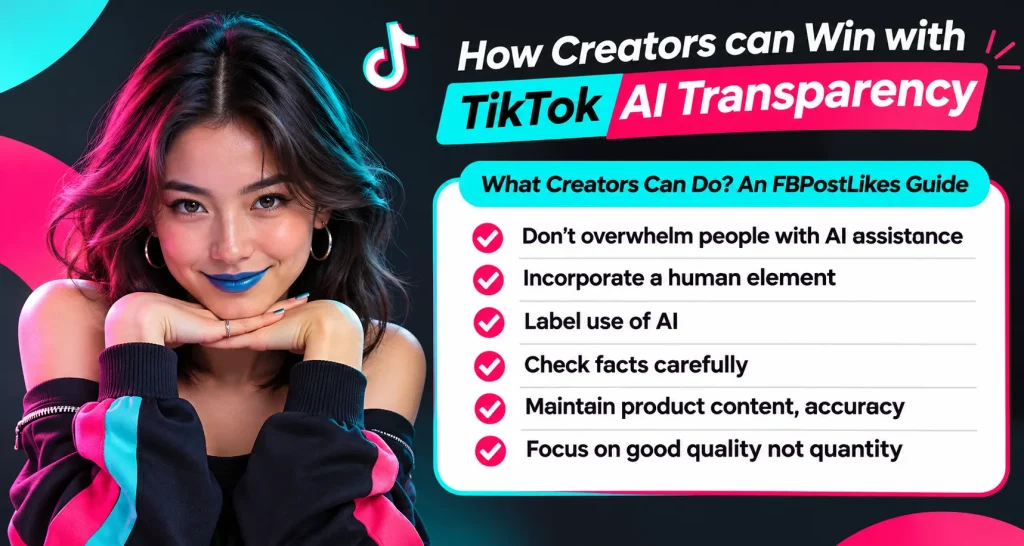
| What Creators Can Do | Why It Matters |
| Don’t overwhelm people with AI assistance | Use AI to do research, writing scripts, editing content and ideas, but don’t make generic low effort videos. |
| Incorporate a human element | Content can be more difficult to duplicate because it is based on personal experience, opinion, expertise and firsthand observations. |
| Label use of AI | When realistic people or voices, scenes or events are created or significantly modified using artificial intelligence, transparency fosters trust. |
| Check facts carefully | Information created from AI can be off-target, especially in health, finance, politics and current affairs. |
| Maintain product content, accuracy | Prevention of AI visuals or misleading claims about a product’s look, function, safety, or capabilities. |
| Focus on good quality not quantity | While there could be more engaging videos filled with the same information, the key may be fewer, but more useful and distinct. |
- Use AI to Assist, Not Flood
AI can help speed up research, ideation, editing, scripting, subtitles and visual experimentation.
The risk comes when speed becomes the main objective.
You could publish 30 generic videos because AI makes that possible. But that might be less valuable than publishing five distinctive videos that have real expertise, personality or creative thought.
- Add Something Only You Can Add
Originality becomes especially important when AI tools can generate average content quickly. creators can stand out by
- Personal stories
- Origin Opinions
- Live demos
- Original footage.
- Unique humor
- Analysis by experts
- Interviews
- Behind the scenes material
- Customer or community insights
AI can support these formats without becoming the entire product.
- Label Significant AI Use
If realistic people, voices, scenes, or events have been substantially generated or altered by AI, creators should use TikTok’s available disclosure tools and follow the platform’s current rules.
Do not assume viewers will never know.
The technology of provenance and automated detection is getting better.
- Be Extra Careful With Products and Endorsements
Creators selling or promoting products also need accuracy.
TikTok’s commerce guidance says AI should not be used to misrepresent a product’s size, colour, material, quantity, performance, safety characteristics or capabilities. AI-generated false endorsements and impersonation are also restricted.
An attractive AI visual is not worth creating if it gives buyers the wrong impression about the actual product.
To Sum It Up
With TikTok AI transparency, it is not asking creators to choose between AI and creativity. It is drawing a clearer line between AI used as a creative tool and AI used to generate misleading, repetitive, or low-value spam.
Creators can still use AI. But they should use it transparently, responsibly and with enough human input to make the finished content genuinely worth watching.
The future advantage may not belong to the creator who can produce the most videos. It may belong to the creator who uses AI efficiently while still giving audiences something automation cannot easily reproduce: experience, judgment, personality and trust.
FAQs
Does TikTok ban AI-generated content?
No. TikTok allows AI-generated content when it follows platform rules. Creators should disclose realistic or substantially AI-generated material and avoid misleading, harmful, or deceptive uses.
Will TikTok penalize creators for using an AI-generated content label?
TikTok says applying an AI-generated content label does not automatically restrict a post. The label is intended to improve transparency and help viewers understand what they see.
What type of AI content is TikTok targeting as spam?
TikTok is testing stronger detection for accounts dedicated to mass-producing AI spam, particularly around sensitive topics such as politics, current events, financial advice and medical information.


