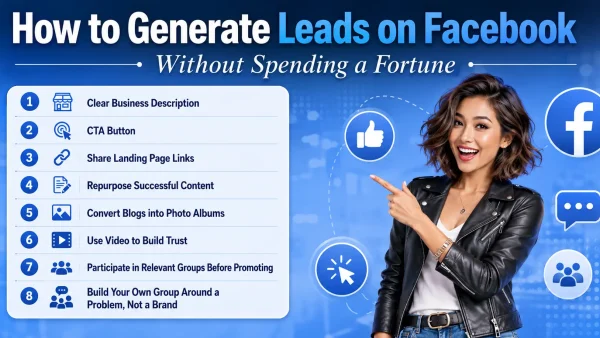
Why Private Facebook Communities like Messenger Matter in 2027?
Facebook communities like groups, broadcast channels and Messenger are becoming a favorite in 2027. They create deeper engagement and stronger trust. The result is a more direct relationship than public feed interactions alone.
That does not mean the public feed is disappearing. It means some of the most meaningful interactions are increasingly happening in smaller spaces such as Facebook Groups, Messenger conversations, Messenger Communities, and broadcast channels.
For brands and creators, this shift would be an important marketing signal.
Public posts are still useful for reach. Reels can introduce a business to new people and ads can generate awareness quickly. But trust, recommendations, repeat interaction, and buying conversations often happen somewhere more focused.
The result is a space for Facebook communities where reach still matters, but relationship depth matters more than before.
Why Private Facebook Communities Are Becoming Important Again
For years, Facebook focused heavily on public visibility for generating revenue. More followers. More impressions. More comments. More viral posts. These metrics still matter, but they do not always show where buying decisions are influenced.
Someone may discover a product in the feed, ask friends about it in Messenger, and later search for recommendations inside a niche Facebook Group. A person considering a major purchase may trust a detailed answer from another community member more than a polished branded post. These interactions are harder to measure because much of the activity happens outside public feeds.
Private and semi-private Facebook communities offer something the main feed cannot always provide: relevance, context, and conversation among people with a shared interest.
Facebook Groups Are Becoming More Purposeful
Facebook Groups have existed for years, but Meta is investing in them again as a crucial part of Facebook communities.
In 2027, Facebook introduced Forum, a purpose built app for people who want to go deeper into their Facebook Groups. It brings existing groups together and focuses on finding useful advice, recognizing helpful community voices, and making participation easier.
That signals something important.
Groups are no longer simply side features attached to Facebook Pages. Meta is treating community participation as a distinct use case.
People Want Firsthand Advice
One reason Groups continue to matter is that users can ask questions that require experience rather than generic information.
Someone might ask:
“Which stroller works well on rough roads?”
“Has anyone used this accounting software for a small agency?”
“Which neighbourhood is best for families moving here?”
These questions invite real experiences. Search engines and AI can provide information, but many users still value answers from people who have faced the same problem. For marketers, this makes niche communities useful for understanding what customers actually care about.
Helpful Members Can Become More Influential
Community credibility does not always come from the brand. Sometimes the most trusted person in a Group is an experienced customer, enthusiast, local resident, or industry practitioner.
That changes how brands should participate. A strong Group should create space for members to help one another rather than making every discussion revolve around the company.
Messenger Is Turning Community Into Conversation
Facebook Groups organize people around common interests. But Messenger moves those relationships into faster, more personal conversations.
Meta has continued expanding Messenger beyond simple one-to-one chats. Messenger Communities and newer group-oriented features show that the platform is trying to make private conversation more useful for shared interests and real-time interaction.
For businesses, this creates another layer between public discovery and customer action, especially when Facebook is also used as a lead generation medium.
Why Messenger Matters for Brands
Messenger works well because it feels closer to conversation than broadcasting. A customer may ignore a Page post but respond to a useful Messenger update. Or someone might feel more comfortable asking a detailed question in a chat rather than posting it publicly.
Messenger can support:
- Customer questions
- Product recommendations
- Event reminders
- Community conversations
- Customer support
- Follow-up after engagement
- VIP updates
The challenge is tone.
Messenger is a personal environment, so aggressive promotion can quickly feel intrusive. The strongest use of Messenger is usually service, support or communication that gives people a clear reason to stay engaged.
Broadcast Channels Offer a Different Type of Connection
Broadcast channels need a little clarification. They are not private in the same way as other Facebook communities like a closed Facebook Group or Messenger thread. Facebook and Messenger broadcast channels are public, discoverable, one-to-many messaging spaces. Page admins can send updates while members can react or participate in polls.
So why do they matter in this discussion?
It’s because they look more like direct community interaction than normal feed posts.
Followers actively choose to join the channel. Once inside, they receive updates in a chat-like environment instead of relying entirely on the feed algorithm to surface every message.
That creates a more intentional relationship.
A brand could use a broadcast channel for-
- Product drops
- Early announcements
- Behind-the-scenes updates
- Event reminders
- Limited offers
- Polls
- Quick updates
- Exclusive content
The audience is self-selected. That often means people inside the channel are already more interested than the average follower.
Public Reach And Private Engagement Work Together Now
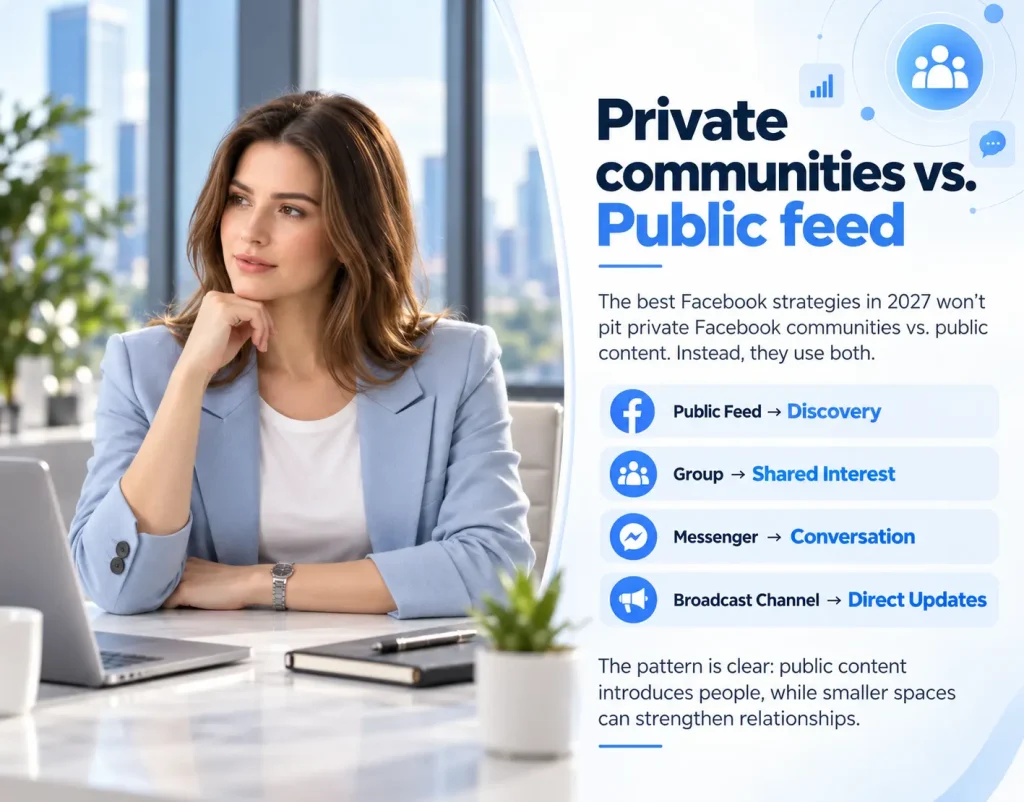
The best Facebook strategies in 2027 won’t pit private Facebook communities vs. public content. Instead, they use both.
Think of it like this:
Public Feed → Discovery
Group → Shared Interest
Messenger → Conversation
Broadcast Channel → Direct Updates
A Reel might attract someone while a Group could deepen their interest. Similarly, a Messenger conversation might answer a question and a broadcast channel could keep them informed about future launches.
This is not a strict Facebook funnel. People can move between these Facebook communities in different ways. But the pattern is clear: public content introduces people, while smaller spaces can strengthen relationships.
Why Trust Matters More in the AI Era
There is another reason Facebook communities are becoming more valuable. AI is making content easier to create. That means users are seeing more posts, more videos, more opinions, and more automated material than before.
As content volume increases, people may place greater value on knowing who is behind the information. A recommendation from someone who has participated in a Group for two years may feel more meaningful than a random sponsored post.
Repeated conversations create familiarity.
Familiarity can build trust.
This gives private communities an advantage that mass-reach content does not always have.
Community Data Will Not Always Appear in Your Dashboard
This shift also creates a measurement problem. Traditional social analytics focus on visible activity such as impressions, clicks, reactions, and public comments. But private conversations in Facebook communities are harder to track.
Someone may copy a link from your Page and send it into a Messenger group. Ten people discuss the product and one eventually buys. Your analytics may show the sale but not the conversation that influenced it. That means marketers may need to look beyond standard engagement metrics.
Useful indicators could include:
- Group participation
- Repeat contributors
- Questions asked
- Messenger conversations
- Broadcast channel membership
- Poll participation
- Referral traffic
- Customer mentions of community recommendations
Community value is often qualitative before it becomes quantitative.
Brands Should Facilitate, Not Dominate
The biggest mistake businesses can make is turning every community into another advertising channel. People join Facebook communities because they want value. They want advice, discussion, information, belonging, or access.
If every Group post becomes a promotion, members stop participating.
If every Messenger message becomes a sales pitch, people mute the conversation.
If every broadcast update says “Buy now,” the channel loses its purpose.
Brands should think more like hosts. Create useful conversations and answer questions. Also encourage members to help each other. Share information that feels worth receiving. You can promote, but it has to be part of the community naturally.
What This Means for Facebook Marketing in 2027
Facebook marketing is becoming less about collecting the largest possible audience and more about building multiple levels of connection. Public feeds remain essential for awareness. But Groups, Messenger, and broadcast channels give brands something public reach cannot always deliver: depth.
This is crucial because loyal customers are rarely created by one post. They are built through repeated useful interactions.
Facebook’s renewed investment in Groups, community tools, Messenger experiences and broadcast channels all point in the same direction. This means that Facebook communities are becoming a bigger part of the platform’s identity again.
Final Thoughts
Private Facebook communities are not replacing the public feed. But they are becoming the layer where stronger relationships can develop. Groups bring people together around shared interests. Messenger supports more personal conversation. Broadcast channels give Pages a direct line to highly interested followers.
For brands, the opportunity is not simply to create more places to publish content.
It is to create spaces where people actually want to participate.
In 2027, the most valuable Facebook audience may not always be the biggest one. It may be the group of people who keep coming back and asking questions. They would prefer sharing experiences and trusting the community enough to act on what they learn.
FAQs
Why are Facebook Groups becoming important again in 2027?
Facebook Groups are becoming more important again because it’s a place to have conversations. Users can access peer recommendations and first-hand advice with Facebook communities. The Forum app provides a direct space for groups to interact.
Are Facebook broadcast channels private?
No. Broadcast channels are not private. They are public. Anyone can find them. Users choose to join them actively. This makes the communication feel more direct and community-focused compared to feed posts.
How are private Facebook communities different from Facebook Pages?
Pages are mainly used to publish content to followers. Groups and Messenger are better for discussions asking questions and sharing recommendations. These Facebook communities also support relationships, between members, customers and brands.